Pulsar Python SDK
API reference
Public types exported by:
Start with Core concepts and workflow for object ownership and the normal lifecycle. Use this page for exact constructors, methods, records, enum values, and exceptions.
Browse the API
| Area | Contents |
|---|---|
| Domains | USB, CAN, and virtual execution domains |
| Actuators | Common, physical, and virtual actuator APIs |
| Groups and platforms | Multi-actuator composition and lifecycle |
| Records | Configuration, status, diagnostics, and results |
| Enumerations | Lifecycle, modes, diagnostics, parameters, telemetry, and capabilities |
| Exceptions | SDK exception hierarchy |
The right-side table of contents lists each API area and public type.
Diagrams
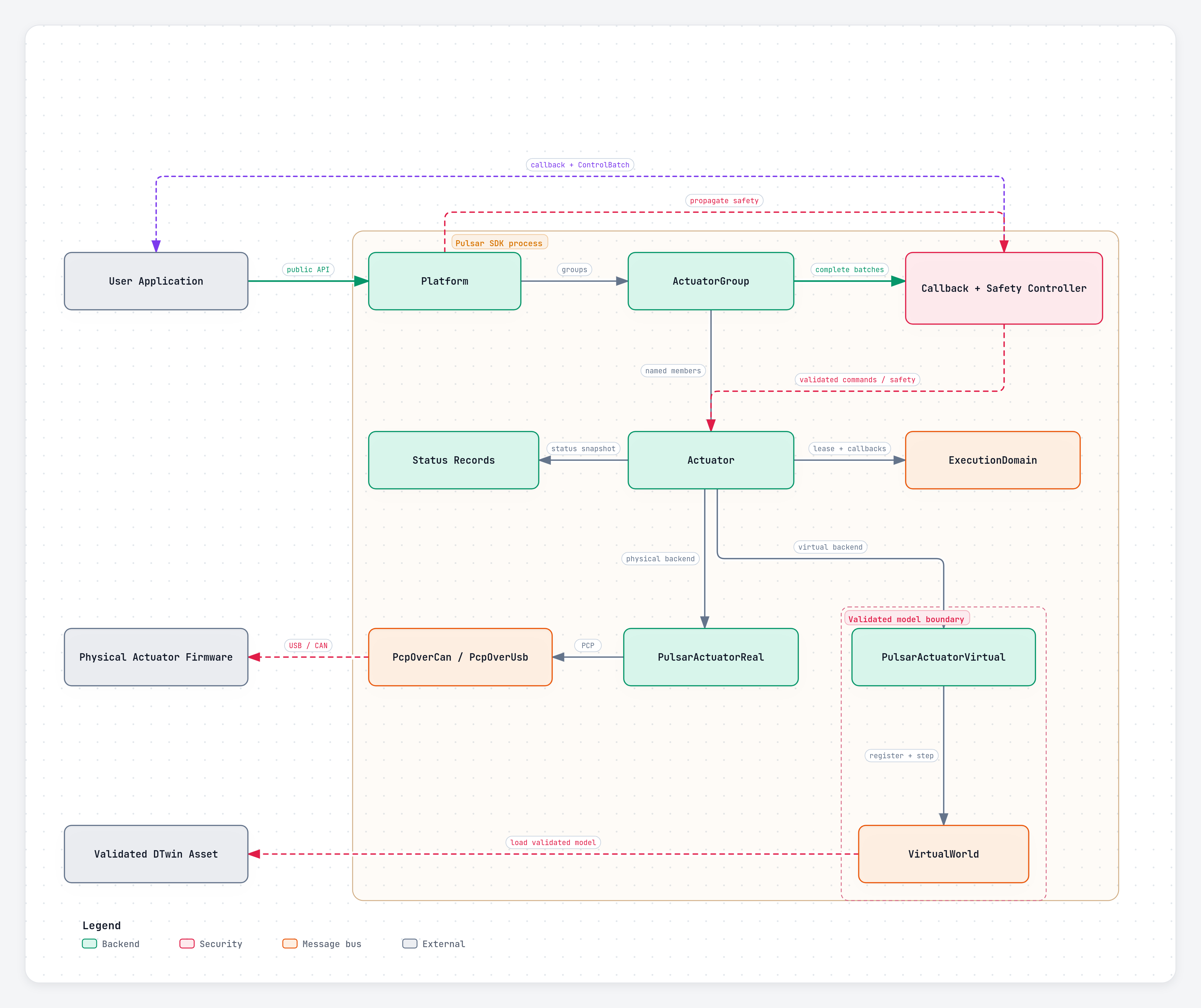
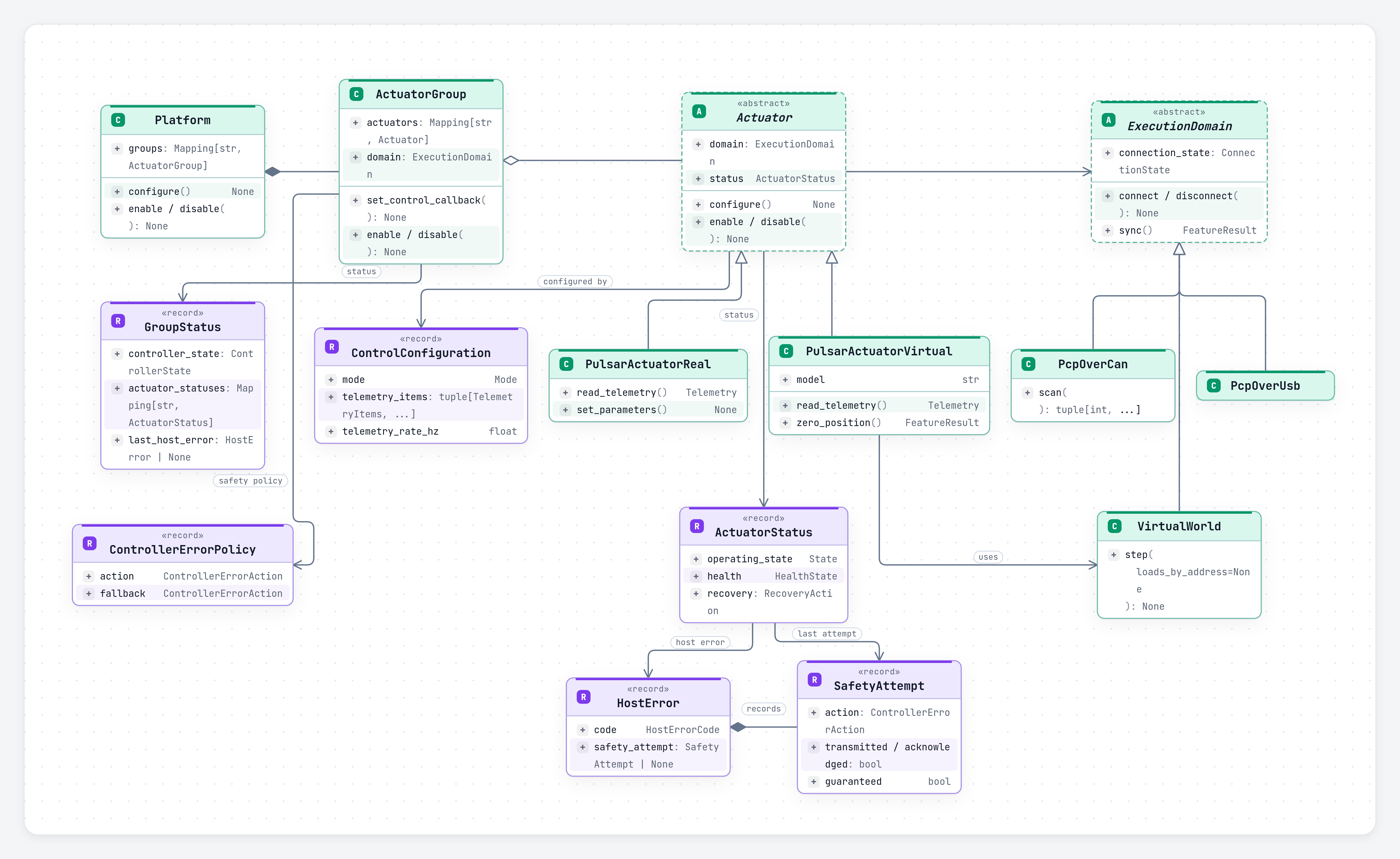
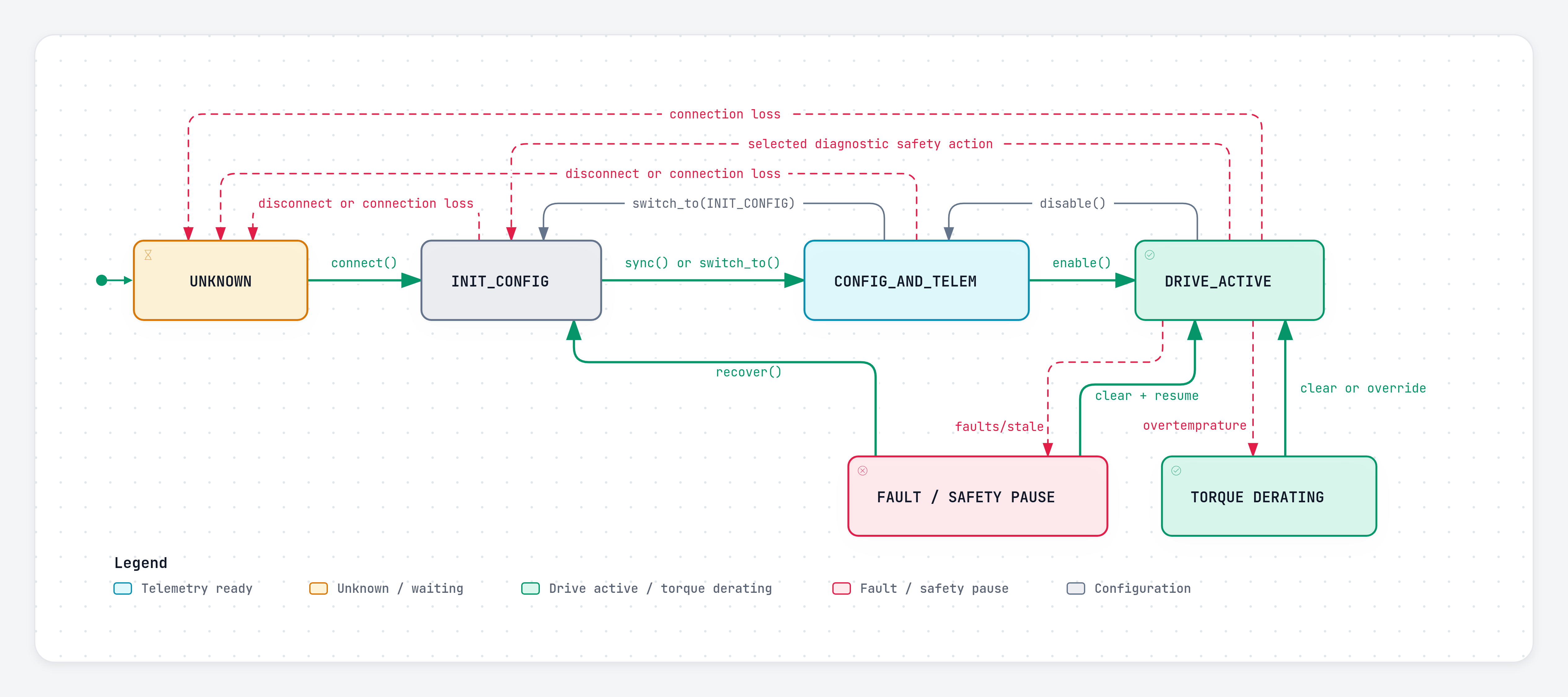
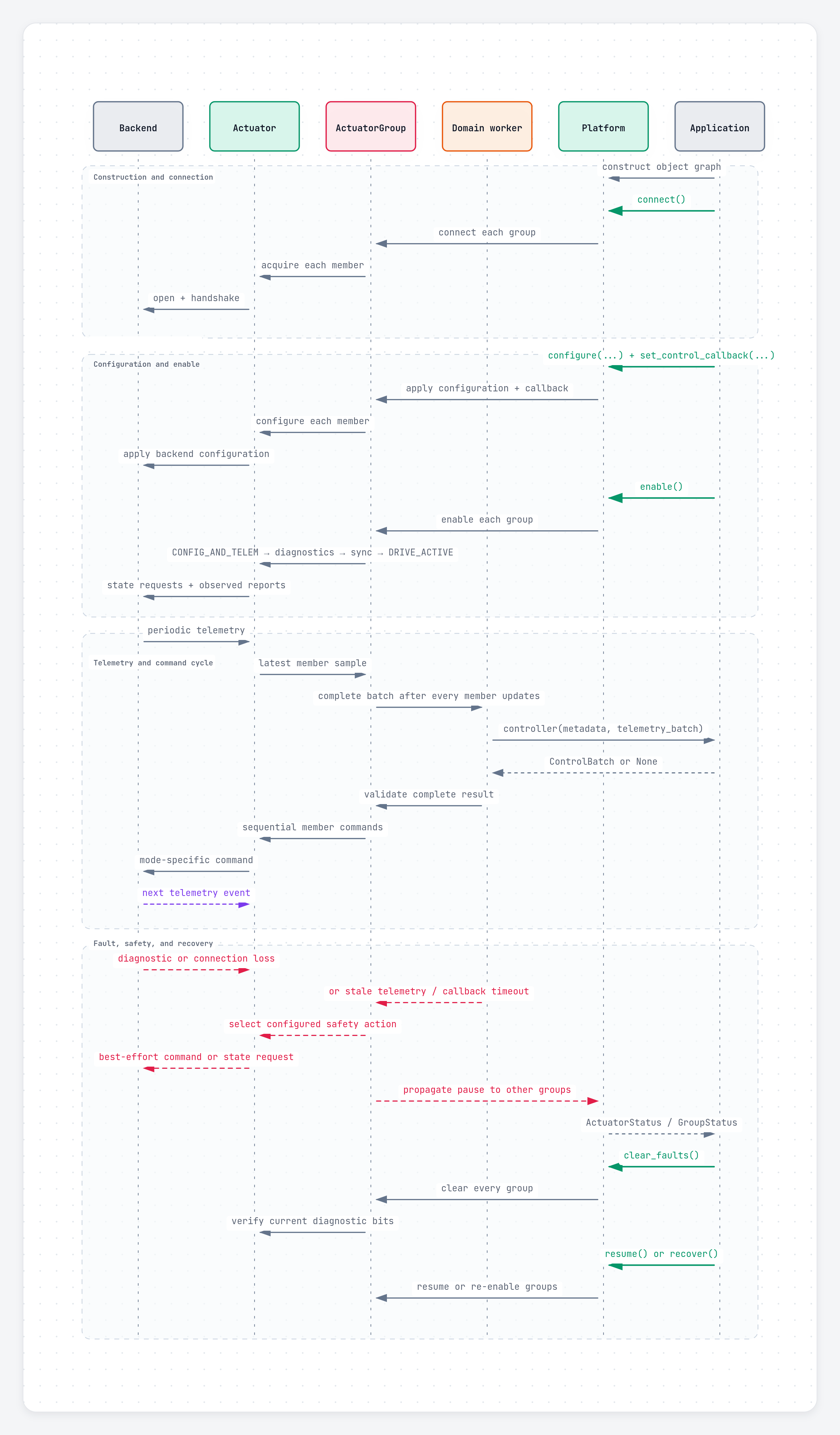
Type aliases and callbacks
Telemetry = dict[TelemetryItems, int | float]
TelemetryBatch = dict[str, Telemetry]
ControlValues = dict[ControlParams, float]
ControlBatch = Mapping[str, Mapping[ControlParams, float]]

ControlCallback = Callable[
    [ControllerMetadata, TelemetryBatch],
    ControlBatch | None,
]

DiagnosticCallback = Callable[
    [ActuatorGroup, Actuator, ActuatorDiagnostic],
    None,
]
An actuator-level telemetry callback has this signature:
An actuator-level diagnostic callback has this signature:
Domains
ExecutionDomain
Base class for one transport or simulation clock. It also owns the callback worker, telemetry watchdog, and actuator leases.
Properties
capabilities: Capabilityconnection_state: ConnectionStateis_connected: bool
Methods
supports(capability: Capability) -> bool— Return whether the domain advertises the capability.connect() -> None— Explicitly keep the domain open. Repeated calls are safe.disconnect() -> None— Release the explicit connection. RaisesResourceBusyErrorwhile connected actuators still use the domain.sync() -> FeatureResult— Reset telemetry timestamps and counters for the domain when supported.reset_telemetry_timestamp() -> FeatureResult— Same operation assync().
The class supports with; entering connects and exiting disconnects.
PcpOverCan
PCP domain for one USB-to-CAN adapter.
list_ports() -> tuple[str, ...]— List detected Pulsar serial ports.scan(start_address=16, end_address=255, *, timeout_s=0.12) -> tuple[int, ...]— Probe the inclusive address range. The domain connects automatically if needed.set_can_brs_enabled(enabled: bool) -> None— Update connected actuators while output is inactive. Enabling BRS is verified and rolled back on failure.
CAN actuator addresses must be unique within the domain and lie in 16..16382. Scan bounds use the same range, start_address must not exceed end_address, and timeout_s must be finite and positive.
PcpOverUsb
Direct-USB domain for exactly one actuator at address 0.
list_ports() -> tuple[str, ...]— List detected Pulsar serial ports.
VirtualWorld
VirtualWorld(
    *,
    time_step_hz: float = 20_000,
    assets_path: str | Path | None = None,
    logger: logging.Logger | None = None,
)
Deterministic digital-twin domain. The current model assets require exactly 20_000 Hz.
Attributes
time_step_hz: floattime_step_s: floatassets_path: Path | None— Explicit asset root, if supplied.simulation_time_s: floatsimulation_step_count: int
Methods
scan() -> tuple[str, ...]— Return available packaged models for the current host. Current supported names areP90,P100,PULSE98-30G,PULSE98-55G,PULSE115-60G, andPULSE115-110G.sync() -> FeatureResult— Reset virtual telemetry timestamps and counters without resetting plant physics.step(*, loads_by_address: Mapping[int, float] | None = None) -> None— Advance connected models to the earliest next telemetry event and wait for due callbacks. If no periodic telemetry is configured, advance one model tick.
Without assets_path, lookup checks PULSAR_ASSETS_PATH, then the active Conda prefix and Python environment prefix under share/pulsar-assets and Library/share/pulsar-assets.
Loads must be finite numbers keyed by connected virtual actuator address.
Actuators
Actuator
Actuator(
    domain: ExecutionDomain,
    *,
    address: int | None,
    capabilities: Capability = Capability.NONE,
    diagnostic_actions: Mapping[DiagnosticFlag, ControllerErrorAction] | None = None,
    diagnostic_damping: float | None = None,
    logger: logging.Logger | None = None,
)
Backend-neutral actuator contract. Most users create PulsarActuatorReal or PulsarActuatorVirtual instead.
diagnostic_actions maps named DiagnosticFlag values to safety actions. Defaults are:
DiagnosticFlag.OVERTEMPERATURE→LIMIT_TORQUEDiagnosticFlag.INTERNAL_ENCODER_ERRORandEXTERNAL_ENCODER_ERROR→INIT_CONFIG- other unmapped error diagnostics →
DEFAULT_SAFETY
Map a diagnostic to DO_NOTHING to keep it report-only: callbacks and status.diagnostic still update, but it does not fault, inhibit, pause, propagate safety, or block direct commands/enabling. Mapping every DiagnosticFlag provides the explicit destructive-testing configuration.
diagnostic_damping must be None or a finite positive value.
Properties
domain: ExecutionDomain— Owning domain.address: int | None— Read-only transport or virtual identifier.capabilities: Capabilityconnection_state: ConnectionStateis_connected: boolstatus: ActuatorStatus— Includes the current and last observed operating state, connection, health, diagnostic, safety, and recovery information.mode: Mode | Noneinfo: DeviceInfodropped_telemetry_packets: int— Pending actuator callback packets replaced by newer packets.
Lifecycle and control
connect() -> None— Connect the actuator and acquire its domain.disconnect() -> None— Request the backend safe disconnect state and release the domain lease.configure(configuration: ControlConfiguration) -> None— Apply mode and periodic telemetry configuration inINIT_CONFIGorCONFIG_AND_TELEM.set_mode(mode: Mode) -> None— Change mode while drive output is inactive. The cached mode changes only after the backend update succeeds.switch_to(state: State) -> None— RequestINIT_CONFIG,CONFIG_AND_TELEM, orDRIVE_ACTIVE.UNKNOWNcannot be requested.sync() -> FeatureResult— Move toCONFIG_AND_TELEMwhen needed, then synchronize the whole domain.enable() -> None— Check configuration and diagnostics, synchronize when required, and enterDRIVE_ACTIVE.disable() -> None— EnterCONFIG_AND_TELEM.set_command(command: float | Mapping[ControlParams, float]) -> None— Send a primary command or a validated mode-specific control mapping inDRIVE_ACTIVE. A mapping must includeControlParams.COMMAND; omitted optional packet fields remain unchanged by firmware.
When the actuator belongs to a group, lifecycle and configuration operations are routed through that group.
Telemetry and callbacks
read_telemetry(items: Iterable[TelemetryItems]) -> Telemetry— Read a snapshot inCONFIG_AND_TELEMorDRIVE_ACTIVE.set_telemetry_callback(callback: Callable[[int | None, Telemetry], None] | None) -> None— Register or remove an actuator callback. One callback may run while one newest packet waits.set_diagnostic_callback(callback: Callable[[Actuator, ActuatorDiagnostic], None] | None) -> None— Register or remove an actuator diagnostic callback.
Parameters and optional features
read_parameters(parameters: Iterable[Parameters]) -> dict[Parameters, int | float]set_parameters(parameters: Mapping[Parameters, int | float]) -> None— Allowed only while drive output is inactive.set_torque_gain_preset(preset: TorqueGainPreset) -> FeatureResultset_velocity_gain_preset(preset: VelocityGainPreset) -> FeatureResultzero_position() -> FeatureResult— Allowed inCONFIG_AND_TELEMorDRIVE_ACTIVE. Position and impedance modes reset the COMMAND to zero to avoid sudden motion.identify() -> FeatureResultset_address(address: int) -> FeatureResultsave_parameters() -> FeatureResultenter_bootloader() -> FeatureResultsupports(capability: Capability) -> bool
Unsupported optional operations return FeatureResult(UNSUPPORTED, ...) unless the operation is invalid for the current lifecycle state.
Fault and diagnostic methods
clear_faults() -> bool— Verify current diagnostics, clear retained SDK faults when possible, and restore thermal torque limits afterOVERTEMPERATUREclears. ReturnsFalsewhile a mapped diagnostic remains active.recover() -> None— Recover a diagnostic whose selected action enteredINIT_CONFIG. This is not a general host-fault clear method.resume() -> None— Resume a healthy standalone actuator. If output is inactive, this runs the normal enable checks before enteringDRIVE_ACTIVE. A grouped actuator routes the call through its group.override_diagnostic_safety(flags: Iterable[DiagnosticFlag]) -> None— Bypass SDK safety for currently active named diagnostics. Overrides expire when those diagnostics clear. This is a dangerous operation.
The class supports with; entering connects and exiting disconnects.
PulsarActuatorReal
PulsarActuatorReal(
    domain: ExecutionDomain,
    address: int,
    *,
    diagnostic_actions: Mapping[DiagnosticFlag, ControllerErrorAction] | None = None,
    diagnostic_damping: float | None = None,
    logger: logging.Logger | None = None,
)
Physical actuator using Pulsar Communication Protocols (PCP).
inforeports model and firmware version.- Physical state requests complete only after the requested state is observed.
- Connection reads and caches maximum torque and the current torque limit for thermal safety.
- CAN-backed actuators advertise
ADDRESS_CHANGE; USB-backed actuators do not. - Physical maintenance methods may return
UNCONFIRMEDbecause transmission has no dedicated acknowledgement.
PulsarActuatorVirtual
PulsarActuatorVirtual(
    domain: VirtualWorld,
    *,
    model: str,
    address: int | None = None,
    diagnostic_actions: Mapping[DiagnosticFlag, ControllerErrorAction] | None = None,
    diagnostic_damping: float | None = None,
    logger: logging.Logger | None = None,
)
Generated digital-twin actuator.
model: str— Requested model name.inforeports the model name and generated model version.- An omitted address is allocated monotonically within the world.
- Explicit addresses must be unique integers in
0..16382. - The plant remains enabled as a passive zero-torque model in
INIT_CONFIGandCONFIG_AND_TELEM, so external loads can still move it. - Telemetry is not available in
INIT_CONFIG. identify()returnsUNSUPPORTED.
Groups
ActuatorGroup
ActuatorGroup(
    name: str,
    actuators: Mapping[str, Actuator],
    *,
    telemetry_timeout_s: float = 0.1,
    controller_timeout_s: float | None = 1.0,
    controller_error_policy: ControllerErrorPolicy | None = None,
    logger: logging.Logger | None = None,
)
A named set of actuators that share one domain and one control mode. The group name, member mapping, and every member name must be non-empty; members must be distinct actuator objects from one domain.
telemetry_timeout_s and a non-None controller_timeout_s must be finite and positive. Set controller_timeout_s=None to disable the callback deadline.
Properties
name: stractuators: Mapping[str, Actuator]— Read-only view.domain: ExecutionDomainconnection_state: ConnectionStateis_connected: boolcontroller_state: ControllerStatestatus: GroupStatus
Lifecycle
connect() -> None— Connect every member; roll back earlier connections if a later member fails.disconnect() -> None— Stop callbacks, apply output-inactive safety where needed, and release group leases.close(*, disconnect_actuators: bool = True) -> None— Disconnect, detach members, and make the group unusable.configure(configuration: ControlConfiguration) -> None— Apply one configuration to every member. A partial failure invalidates the group configuration until the whole group is configured again.set_mode(mode: Mode) -> None— Change every member while all drives are inactive.switch_to(state: State) -> None— Request one state for every member and report aggregate failure.sync() -> FeatureResult— EnterCONFIG_AND_TELEMwhere needed and synchronize the shared domain.reset_telemetry_timestamp() -> FeatureResult— Same operation assync().enable() -> None— Check faults and diagnostics, synchronize when required, then enable every member. Failure attempts rollback toCONFIG_AND_TELEM.disable() -> None— Move every member toCONFIG_AND_TELEM.zero_position() -> dict[str, FeatureResult]— Zero every member inCONFIG_AND_TELEMorDRIVE_ACTIVE.
Commands, parameters, and presets
set_commands(commands: ControlBatch) -> None— Validate a selected member batch before the first write. Each member mapping accepts the same mode-specificControlParamsas standaloneset_command().read_parameters(parameters: Mapping[str, Iterable[Parameters]]) -> dict[str, dict[Parameters, int | float]]set_parameters(parameters: Mapping[str, Mapping[Parameters, int | float]] | Mapping[Parameters, int | float], *, unify: bool = False) -> Noneset_torque_gain_presets(presets: Mapping[str, TorqueGainPreset] | TorqueGainPreset, *, unify: bool = False) -> dict[str, FeatureResult]set_velocity_gain_presets(presets: Mapping[str, VelocityGainPreset] | VelocityGainPreset, *, unify: bool = False) -> dict[str, FeatureResult]save_parameters() -> dict[str, FeatureResult]
With unify=False, mappings are keyed by actuator name. With unify=True, one flat parameter map or one preset is applied to every member.
Callbacks and recovery
set_control_callback(callback: ControlCallback | None) -> Noneset_diagnostic_callback(callback: DiagnosticCallback | None) -> Noneclear_faults() -> bool— Attempt every member, then clear group fault state only when all checks pass.resume() -> None— Resume callback control after faults are clear and telemetry is fresh. If output is already active, it is not cycled.recover() -> None— Recover members whose diagnostic action selectedINIT_CONFIG.raise_for_host_error() -> None— RaiseControllerFaultErrorwhen a host fault is latched.
The class supports with; entering connects and exiting disconnects.
Platforms
Platform
Top-level composition for lifecycle and safety across one or more domains. The group mapping and every platform group name must be non-empty. A group object cannot appear twice or already belong to another platform.
Properties
groups: Mapping[str, ActuatorGroup]— Read-only view.domains: tuple[ExecutionDomain, ...]— Unique domains in group order.connection_state: ConnectionState— Live aggregate.FAULTEDtakes priority, followed byPARTIALand transition states.is_connected: boolstatus: dict[str, GroupStatus]
Lifecycle
connect() -> None— Connect every group and roll back earlier groups on failure.disconnect() -> None— Attempt every group and report incomplete shutdown.close() -> None— Disconnect and detach groups. Groups and actuators remain reusable.configure(configurations: Mapping[str, ControlConfiguration]) -> None— Requires exactly one configuration per group.set_modes(modes: Mapping[str, Mode]) -> None— Requires exactly one mode per group.switch_to(state: State) -> None— Attempt every group, then report aggregate failure.sync() -> dict[ExecutionDomain, FeatureResult]— Prepare groups and synchronize each domain independently.reset_telemetry_timestamp() -> dict[ExecutionDomain, FeatureResult]— Same operation assync().enable() -> None— Enable groups in order. On failure, attempt to disable every group already enabled.disable() -> None— Attempt every group before reporting failures.zero_position() -> dict[str, dict[str, FeatureResult]]
Commands, parameters, and presets
set_commands(commands: Mapping[str, ControlBatch]) -> None— Validate all selected groups before the first platform write. Nested actuator mappings accept the same mode-specificControlParamsas standaloneset_command().read_parameters(parameters: Mapping[str, Mapping[str, Iterable[Parameters]]]) -> dict[str, dict[str, dict[Parameters, int | float]]]set_parameters(parameters: Mapping[str, Mapping[str, Mapping[Parameters, int | float]]] | Mapping[Parameters, int | float], *, unify: bool = False) -> Noneset_torque_gain_presets(presets: Mapping[str, Mapping[str, TorqueGainPreset]] | TorqueGainPreset, *, unify: bool = False) -> dict[str, dict[str, FeatureResult]]set_velocity_gain_presets(presets: Mapping[str, Mapping[str, VelocityGainPreset]] | VelocityGainPreset, *, unify: bool = False) -> dict[str, dict[str, FeatureResult]]save_parameters() -> dict[str, dict[str, FeatureResult]]
Nested mappings preserve group_name -> actuator_name -> value. unify=True applies one parameter map or preset across all represented actuators and domains.
Callbacks and recovery
set_control_callback(callback: ControlCallback | None) -> None— Register the same callback on every group. Calls remain independent per group.set_diagnostic_callback(callback: DiagnosticCallback | None) -> Noneclear_faults() -> bool— Attempt every group.resume() -> None— Resume every group after validation.recover() -> None— Recover groups withINIT_CONFIGdiagnostic safety, then verify that faults cleared.raise_for_host_error() -> None— Raise one aggregateControllerFaultError.
The class supports with; entering connects and exiting disconnects.
Records
FeatureResult
Properties:
supported: bool—Falseonly forUNSUPPORTED.ok: bool—Trueonly forOK.unsupported: bool—Trueonly forUNSUPPORTED.
DeviceInfo
DeviceInfo(
    model: str,
    serial_number: str | None = None,
    firmware_version: str | None = None,
    model_version: str | None = None,
    control_model_crc: int | None = None,
)
ControlConfiguration
ControlConfiguration(
    mode: Mode,
    telemetry_items: tuple[TelemetryItems, ...] = (),
    telemetry_rate_hz: float = 0.0,
)
actual_telemetry_rate_hz: float— Divider-derived rate based on a 20 kHz clock.- The rate must be
0or1..10_000Hz. - At most 12 unique telemetry items are allowed.
ControllerErrorPolicy
ControllerErrorPolicy(
    action: ControllerErrorAction = ControllerErrorAction.DEFAULT_SAFETY,
    damping: float | None = None,
    fallback: ControllerErrorAction = ControllerErrorAction.INIT_CONFIG,
)
A selected DAMPED_RELEASE needs finite positive damping; otherwise safety uses the fallback action. DO_NOTHING keeps controller errors report-only, retains the previous command, and allows later callback cycles and direct set_commands() calls to continue.
ControllerMetadata
elapsed_time_ms is measured from the group connection time.
ActuatorDiagnostic
ActuatorDiagnostic(
    address: int | None,
    flags: Mapping[DiagnosticFlag, str],
    severity: DiagnosticSeverity | None = None,
    device_timestamp_ms: int | None = None,
)
flags uses DiagnosticFlag keys. Raw integer keys are rejected.
SafetyAttempt
SafetyAttempt(
    action: ControllerErrorAction,
    transmitted: bool,
    acknowledged: bool,
    guaranteed: bool,
    message: str = "",
)
guaranteed is true only when the action was transmitted and acknowledged. Command-based hold, damping, and zero-command actions normally have no operation-specific acknowledgement.
HostError
HostError(
    code: HostErrorCode,
    message: str,
    actuator_addresses: tuple[int | None, ...],
    safety_attempt: SafetyAttempt | None = None,
)
ActuatorStatus
ActuatorStatus(
    operating_state: State,
    last_operating_state: State | None,
    connection_state: ConnectionState,
    health: HealthState,
    recovery: RecoveryAction,
    diagnostic: ActuatorDiagnostic | None = None,
    host_error: HostError | None = None,
    safety_attempt: SafetyAttempt | None = None,
    inhibited_by: str | None = None,
)
Properties:
can_configure: bool— Connected and inINIT_CONFIGorCONFIG_AND_TELEM.commands_effective: bool— Output is enabled and the actuator is healthy and uninhibited.output_enabled: bool— Connected and physically inDRIVE_ACTIVE, including a faulted active hold/damping state.
RecoveryAction.RECOVER means a retained fault needs to be cleared or verified. It does not always mean that the recover() method is the next call; recover() is specifically for INIT_CONFIG diagnostic safety.
GroupStatus
GroupStatus(
    connection_state: ConnectionState,
    controller_state: ControllerState,
    operating_state: State,
    actuator_statuses: Mapping[str, ActuatorStatus] = ...,
    stale_names: tuple[str, ...] = (),
    stale_addresses: tuple[int | None, ...] = (),
    wait_reason: str | None = None,
    last_host_error: HostError | None = None,
    dropped_batches: int = 0,
    timestamp_skew_ms: int = 0,
)
operating_state is UNKNOWN when member states differ.
Enumerations
ConnectionState
| Constant | Value | Meaning |
|---|---|---|
DISCONNECTED |
0 |
No active backend connection. |
CONNECTING |
1 |
Connection is in progress. |
CONNECTED |
2 |
Connection is ready. |
PARTIAL |
3 |
Only part of an aggregate is connected. |
DISCONNECTING |
4 |
Shutdown is in progress. |
FAULTED |
5 |
Connection failed or was lost. |
ControllerState
| Constant | Value | Meaning |
|---|---|---|
STOPPED |
0 |
Callback control is inactive. |
ACTIVE |
1 |
Complete telemetry batches invoke the controller. |
WAITING_FOR_TELEMETRY |
2 |
Control is paused pending explicit recovery or resume. |
FAULTED |
3 |
A host/controller fault is latched. |
State
| Constant | Value | Meaning |
|---|---|---|
UNKNOWN |
0 |
Disconnected or unobserved; not requestable. |
INIT_CONFIG |
1 |
Drive output and runtime telemetry inactive; configuration allowed. |
CONFIG_AND_TELEM |
2 |
Telemetry active; drive output inactive. |
DRIVE_ACTIVE |
3 |
Commands can affect output. |
HealthState
| Constant | Value | Meaning |
|---|---|---|
HEALTHY |
0 |
No retained actuator or host fault. |
HOST_FAULT |
1 |
SDK, controller, or transport fault retained. |
ACTUATOR_FAULT |
2 |
Device error diagnostic retained. |
RecoveryAction
| Constant | Value | Meaning |
|---|---|---|
NONE |
0 |
No recovery action is required. |
RESUME |
1 |
A healthy actuator is paused or inhibited; resume after validation. |
RECOVER |
2 |
A retained fault must be cleared or verified. |
RECONNECT |
3 |
Connection is absent or faulted. |
Mode
| Constant | Value | Command unit |
|---|---|---|
TORQUE |
5 |
N·m |
VELOCITY |
6 |
rad/s |
POSITION |
7 |
rad |
IMPEDANCE |
8 |
position command in rad |
Gain presets
| Type | Constant | Value |
|---|---|---|
TorqueGainPreset |
AGGRESSIVE |
1 |
TorqueGainPreset |
BALANCED |
2 |
TorqueGainPreset |
SOFT |
3 |
VelocityGainPreset |
AGGRESSIVE |
1 |
VelocityGainPreset |
BALANCED |
2 |
VelocityGainPreset |
SOFT |
3 |
FeatureStatus
| Constant | Value | Meaning |
|---|---|---|
OK |
0 |
Operation completed and was confirmed where applicable. |
UNSUPPORTED |
1 |
Backend does not provide the feature. |
FAILED |
2 |
Operation failed. |
UNCONFIRMED |
3 |
Transmission occurred without dedicated confirmation. |
ControllerErrorAction
| Constant | Value | Behavior |
|---|---|---|
DRIVE_INACTIVE |
0 |
Request CONFIG_AND_TELEM. |
HOLD_POSITION |
1 |
Send the latest known position in position or impedance mode. |
DAMPED_RELEASE |
2 |
Use zero stiffness and positive damping in impedance mode; velocity mode sends zero velocity. |
DEFAULT_SAFETY |
3 |
Select hold, damped release, or zero velocity from mode and damping. Torque mode quick-switches to velocity mode and commands zero velocity. |
INIT_CONFIG |
4 |
Request INIT_CONFIG. |
LIMIT_TORQUE |
5 |
Apply diagnostic torque derating. |
DO_NOTHING |
6 |
Report the diagnostic/controller error without changing control, state, inhibition, or command availability. |
DiagnosticFlag
Named firmware diagnostics. Values are firmware bit positions, but applications use the enum names rather than raw integers.
| Constant | Value | Severity class |
|---|---|---|
OVERTEMPERATURE |
0 |
warning |
POSITION_REFERENCE_MAXIMUM |
2 |
warning |
POSITION_REFERENCE_MINIMUM |
3 |
warning |
VELOCITY_TELEMETRY_MAXIMUM |
4 |
warning |
BUS_VOLTAGE_OUT_OF_RANGE |
5 |
warning |
TORQUE_REFERENCE_MAXIMUM |
6 |
warning |
TORQUE_TELEMETRY_MAXIMUM |
7 |
warning |
POSITION_TELEMETRY_MAXIMUM |
8 |
warning |
POSITION_TELEMETRY_MINIMUM |
9 |
warning |
CONTROL_OVERRUN |
12 |
warning |
COMMUNICATION_OVERRUN |
13 |
warning |
CURRENT_MAXIMUM |
16 |
error |
INVALID_LIMITS |
17 |
error |
BUS_VOLTAGE_CRITICAL_RANGE |
29 |
error |
INTERNAL_ENCODER_ERROR |
30 |
error |
EXTERNAL_ENCODER_ERROR |
31 |
error |
DiagnosticSeverity
| Constant | Value |
|---|---|
INFO |
0 |
WARNING |
1 |
ERROR |
2 |
HostErrorCode
| Constant | Value | Meaning |
|---|---|---|
CONTROLLER_EXCEPTION |
1 |
Controller callback raised. |
INVALID_CONTROLLER_OUTPUT |
2 |
Controller returned an invalid command batch. |
CONNECTION_LOST |
3 |
Transport connection was lost. |
SAFETY_ACTION_FAILED |
4 |
Selected host safety action failed or could not be confirmed. |
STALE_TELEMETRY |
5 |
Required callback telemetry became stale. |
COMMAND_TRANSMISSION_FAILED |
6 |
A callback command write failed. |
CONTROLLER_TIMEOUT |
7 |
Controller callback exceeded its deadline. |
Parameters
Parameter reads are backend-specific. Writes are allowed only while drive output is inactive.
These values are directly writable with set_parameters():
- impedance gains:
IMPEDANCE_DAMPING,IMPEDANCE_STIFFNESS; - torque, position, velocity, profile-velocity, and profile-acceleration limits;
- loop gains:
VELOCITY_KP,VELOCITY_KI,POSITION_KP,FEEDFORWARD_GAIN; DIRECTION_INVERTED,VELOCITY_FILTER_CUTOFF,CURRENT_FILTER_CUTOFF, andCAN_BRS_ENABLED.
The following values require dedicated methods instead:
MODE→set_mode();COMMAND→ command methods;TORQUE_GAIN_PRESETandVELOCITY_GAIN_PRESET→ preset methods;PCP_ADDRESS→set_address();TELEMETRY_RATE_HZ→configure().
These fields are read-only: RATED_VELOCITY_RAD_S, MAXIMUM_TORQUE_NM, FIRMWARE_VERSION, SERIAL_NUMBER, DEVICE_MODEL, and CONTROL_MODEL_CRC. A backend may reject an otherwise writable field that its device or model does not provide.
For CAN BRS, prefer PcpOverCan.set_can_brs_enabled(). It coordinates all connected actuators, verifies the new setting, and rolls back a failed enable.
| Constant | Value | Meaning |
|---|---|---|
IMPEDANCE_DAMPING |
1 |
Impedance damping gain. |
IMPEDANCE_STIFFNESS |
2 |
Impedance stiffness gain. |
TORQUE_LIMIT |
4 |
Torque limit in N·m; +inf restores the unbounded software default. |
POSITION_LIMIT_MAX |
5 |
Maximum position in rad; +inf is unbounded. |
POSITION_LIMIT_MIN |
6 |
Minimum position in rad; -inf is unbounded. |
VELOCITY_LIMIT_MAX |
7 |
Maximum velocity in rad/s; +inf is unbounded. |
VELOCITY_LIMIT_MIN |
8 |
Minimum velocity in rad/s; -inf is unbounded. |
POSITION_PROFILE_VELOCITY_MAX |
9 |
Positive position-profile velocity limit; +inf is unbounded. |
POSITION_PROFILE_VELOCITY_MIN |
10 |
Negative position-profile velocity limit; -inf is unbounded. |
VELOCITY_PROFILE_ACCELERATION_MAX |
11 |
Positive velocity-profile acceleration limit; +inf is unbounded. |
VELOCITY_PROFILE_ACCELERATION_MIN |
12 |
Negative velocity-profile acceleration limit; -inf is unbounded. |
VELOCITY_KP |
13 |
Velocity-loop proportional gain. |
VELOCITY_KI |
14 |
Velocity-loop integral gain. |
POSITION_KP |
15 |
Position-loop proportional gain. |
MODE |
48 |
Current mode. |
COMMAND |
49 |
Current primary command. |
TORQUE_GAIN_PRESET |
64 |
Current torque gain preset. |
VELOCITY_GAIN_PRESET |
65 |
Current velocity gain preset. |
RATED_VELOCITY_RAD_S |
66 |
Rated velocity. |
MAXIMUM_TORQUE_NM |
67 |
Maximum actuator torque. |
DIRECTION_INVERTED |
68 |
Direction inversion flag. |
FEEDFORWARD_GAIN |
69 |
Controller feedforward gain. |
VELOCITY_FILTER_CUTOFF |
70 |
Velocity filter cutoff. |
CURRENT_FILTER_CUTOFF |
71 |
Current filter cutoff. |
FIRMWARE_VERSION |
128 |
Encoded physical firmware version. |
PCP_ADDRESS |
129 |
PCP address. |
SERIAL_NUMBER |
130 |
Device serial number. |
DEVICE_MODEL |
131 |
Encoded device model. |
CONTROL_MODEL_CRC |
132 |
Control-model compatibility identifier. |
CAN_BRS_ENABLED |
133 |
CAN bit-rate switching flag. |
TELEMETRY_RATE_HZ |
134 |
Effective periodic telemetry rate. |
TelemetryItems
| Constant | Value | Meaning |
|---|---|---|
INTERNAL_ENCODER_POSITION |
65 |
Internal encoder position. |
INTERNAL_ENCODER_RAW |
66 |
Raw internal encoder count. |
EXTERNAL_ENCODER_POSITION |
67 |
External encoder position. |
EXTERNAL_ENCODER_RAW |
68 |
Raw external encoder count. |
VELOCITY |
69 |
Measured angular velocity. |
PHASE_A_CURRENT |
70 |
Phase-A current. |
PHASE_B_CURRENT |
71 |
Phase-B current. |
PHASE_C_CURRENT |
72 |
Phase-C current. |
TORQUE_SENSOR_MEASUREMENT |
73 |
Calibrated torque-sensor measurement. |
TORQUE_SENSOR_RAW |
74 |
Raw torque-sensor value. |
POSITION_COMMANDED |
75 |
Position reference reported by control. |
POSITION |
76 |
Measured output position. |
VELOCITY_COMMANDED |
77 |
Velocity reference reported by control. |
D_AXIS_CURRENT_COMMANDED |
79 |
Commanded d-axis current. |
D_AXIS_CURRENT_ACTUAL |
80 |
Measured d-axis current. |
Q_AXIS_CURRENT_COMMANDED |
81 |
Commanded q-axis current. |
Q_AXIS_CURRENT_ACTUAL |
82 |
Measured q-axis current. |
D_AXIS_VOLTAGE_COMMANDED |
83 |
Commanded d-axis voltage. |
Q_AXIS_VOLTAGE_COMMANDED |
84 |
Commanded q-axis voltage. |
TORQUE_COMMANDED |
85 |
Torque reference reported by control. |
TORQUE_ESTIMATE |
86 |
Estimated actuator torque. |
PHASE_A_VOLTAGE_COMMANDED |
87 |
Commanded phase-A voltage. |
PHASE_B_VOLTAGE_COMMANDED |
88 |
Commanded phase-B voltage. |
PHASE_C_VOLTAGE_COMMANDED |
89 |
Commanded phase-C voltage. |
BUS_POWER |
90 |
DC bus power. |
BUS_CURRENT |
91 |
DC bus current. |
THREE_PHASE_ELECTRICAL_POWER |
92 |
Three-phase electrical power. |
MECHANICAL_POWER |
93 |
Mechanical output power. |
INVERTER_EFFICIENCY |
94 |
Inverter efficiency. |
MOTOR_EFFICIENCY |
95 |
Motor efficiency. |
INTERNAL_ENCODER_ERROR_COUNT |
96 |
Internal encoder error counter. |
EXTERNAL_ENCODER_ERROR_COUNT |
97 |
External encoder error counter. |
CONTROL_OVERRUN_COUNT |
98 |
Control-loop overrun counter. |
DIAGNOSTIC_FLAGS |
99 |
Firmware diagnostic bitfield. |
TIMESTAMP_MS |
103 |
Device telemetry timestamp in ms. |
PERIODIC_MESSAGE_COUNT |
104 |
Periodic telemetry message counter. |
BUS_VOLTAGE |
112 |
DC bus voltage. |
PCB_TEMPERATURE |
113 |
PCB temperature. |
MOTOR_TEMPERATURE |
114 |
Motor temperature. |
INTERNAL_POSITION_ACTUAL |
115 |
Internal control position. |
ControlParams
Every selected command mapping requires COMMAND. Other fields are valid only in the modes listed below.
| Constant | Value | Allowed modes |
|---|---|---|
COMMAND |
4 |
all modes |
D_AXIS_CURRENT_KP |
193 |
TORQUE |
D_AXIS_CURRENT_KI |
195 |
TORQUE |
Q_AXIS_CURRENT_KP |
194 |
TORQUE |
Q_AXIS_CURRENT_KI |
196 |
TORQUE |
FEEDFORWARD_GAIN |
197 |
VELOCITY, POSITION, IMPEDANCE |
VELOCITY_KI |
198 |
VELOCITY, POSITION |
VELOCITY_KP |
199 |
VELOCITY, POSITION |
TORQUE_FEEDFORWARD |
200 |
VELOCITY, POSITION, IMPEDANCE |
POSITION_KP |
201 |
POSITION |
IMPEDANCE_STIFFNESS |
202 |
IMPEDANCE |
IMPEDANCE_DAMPING |
203 |
IMPEDANCE |
IMPEDANCE_INERTIA |
204 |
IMPEDANCE |
IMPEDANCE_VELOCITY_COMMANDED |
205 |
IMPEDANCE |
IMPEDANCE_ACCELERATION_COMMANDED |
206 |
IMPEDANCE |
Virtual models expose shared d/q current gains. Supplying different finite d-axis and q-axis values in one command raises ValueError.
Capability
| Constant | Value | Meaning |
|---|---|---|
NONE |
0 |
No optional capabilities. |
IDENTIFY |
1 << 0 |
Physical identify action. |
PERSIST_PARAMETERS |
1 << 1 |
Parameter persistence. |
BOOTLOADER |
1 << 2 |
Bootloader entry. |
EXPLICIT_STEP |
1 << 3 |
Explicit simulation stepping. |
EXTERNAL_LOAD |
1 << 4 |
External load input. |
DISCOVERY |
1 << 5 |
Backend discovery. |
ADDRESS_CHANGE |
1 << 9 |
CAN address change. |
CAN_BRS |
1 << 10 |
CAN bit-rate switching. |
Exceptions
SdkError— Base class for SDK runtime errors.ConnectionFailedError— A connect, disconnect, aggregate transition, rollback, or safe shutdown did not complete fully.InvalidLifecycleError— Operation is invalid in the current lifecycle state.ResourceBusyError— Shared resource or callback is currently in use.ControllerFaultError— A retained controller or host fault blocks the requested operation.CommandTransmissionError(message: str, successful_members: tuple[str, ...] = ())— A sequential direct command batch failed.successful_memberslists completed writes.UnsupportedOperationError— Backend or model does not support the operation.