Pulsar Python SDK
Lifecycle and recovery
Operating state, connection state, and health are separate facts. Use Actuator.status and GroupStatus rather than inferring safety from one boolean.
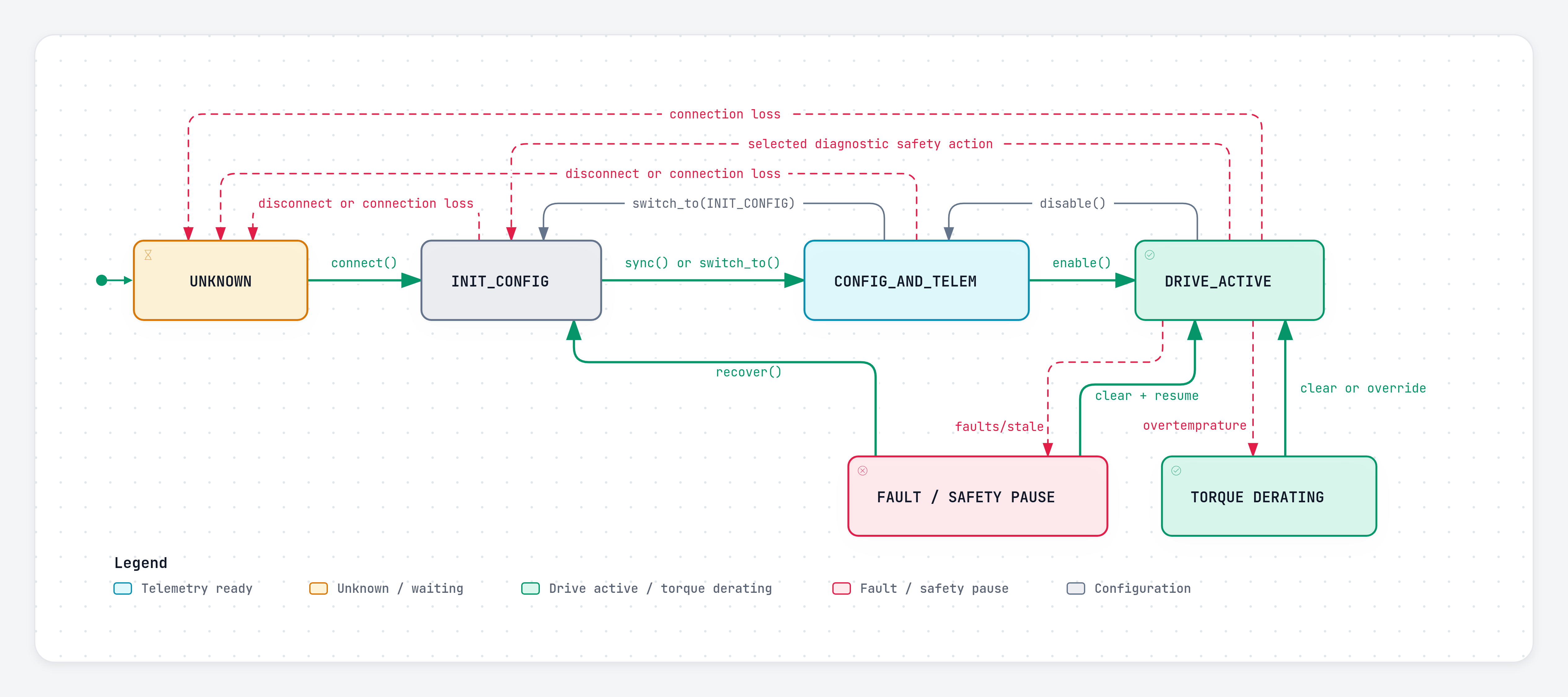
Operating states
| State | Meaning |
|---|---|
UNKNOWN |
disconnected or not observed; cannot be requested |
INIT_CONFIG |
output and runtime telemetry inactive; configuration allowed |
CONFIG_AND_TELEM |
telemetry active; drive output inactive |
DRIVE_ACTIVE |
commands can affect output |
A successful connection ends in INIT_CONFIG. configure() and set_mode() are allowed only in INIT_CONFIG or CONFIG_AND_TELEM; neither enables output. sync() first enters CONFIG_AND_TELEM where needed, then resets telemetry timing for the whole domain.
enable() requires a complete configuration, checks current diagnostics, synchronizes the domain when required, and enters DRIVE_ACTIVE. disable() returns to CONFIG_AND_TELEM, where telemetry remains available while output is inactive.
zero_position() is allowed in CONFIG_AND_TELEM or DRIVE_ACTIVE. In position and impedance modes, the SDK also resets the primary command to zero to avoid sudden motion. Changing mode clears the primary command and command-scoped feedforward or impedance references; configured gains remain in place.
Status
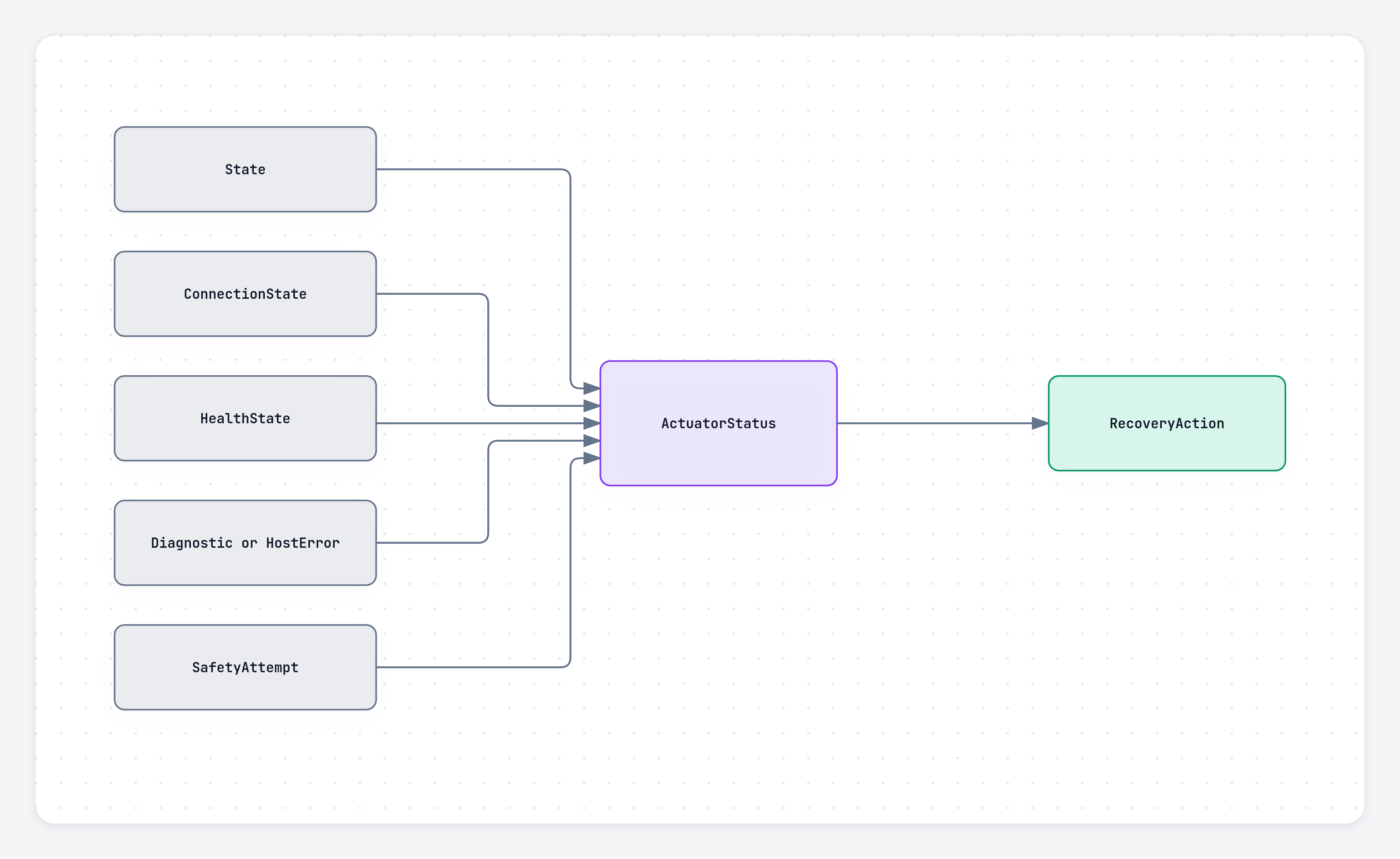
Actuator.status reports:
- current and last observed operating state;
- connection state;
HEALTHY,HOST_FAULT, orACTUATOR_FAULT;- retained device diagnostics and host errors;
- the last safety attempt;
- peer inhibition;
- recommended recovery action.
Default controller safety
The default ControllerErrorPolicy selects a mode-specific action:
| Mode | Default action |
|---|---|
| position | hold an available position; otherwise zero and command zero |
| impedance | hold position; otherwise damped release |
| velocity | command zero velocity |
| torque | enter output-inactive state, switch to velocity, re-enable through the safety path, and command zero velocity |
If the selected action fails, the default fallback requests INIT_CONFIG. Command-based hold, damping, and zero-command actions are best effort because they have no operation-specific device acknowledgement.
Safety applies only while output is active. Diagnostics received while output is inactive are retained and checked before a later enable, but they do not energize output or send active hold commands.
Device diagnostics
Named DiagnosticFlag values are exposed instead of raw bit positions.
Default behavior includes:
- overtemperature → torque derating;
- internal or external encoder error →
INIT_CONFIG; - other unmapped errors → default safety;
- unmapped warnings → reported and logged without automatic safety.
An unexpected observed state change pauses the owning group and propagates safety to reachable group peers and, when present, other platform groups. Operations across actuators and domains are not atomic.
Mode-dependent command safety is applied only while output is active. Diagnostics received while output is inactive are retained and checked before a later enable, but they do not send hold or damping commands, switch modes, or energize output.
Recovery sequences
| Situation | Action |
|---|---|
| Connection lost | reconnect; the previous physical state is unknown |
| Stale telemetry or controller fault | fix the cause, call clear_faults(), then resume() |
| Diagnostic handled while output remains active | wait for it to clear, call clear_faults(), then resume() if paused |
Diagnostic safety entered INIT_CONFIG |
clear the physical condition, call recover(), then resume() or enable() |
clear_faults() verifies current diagnostics and returns False while a mapped condition remains active. recover() is only for diagnostic safety that selected INIT_CONFIG; it is not a general host-fault clear operation.
Advanced policies
ControllerErrorPolicy, diagnostic action mappings, damping, and explicit diagnostic overrides are documented in the API reference.
Danger
ControllerErrorAction.DO_NOTHING and override_diagnostic_safety() can suppress automatic safety behavior. Use them only for a controlled, reviewed application with an independent safety plan.
Connection loss and shutdown
After transport loss, the SDK reports UNKNOWN and preserves the previous observation in status.last_operating_state. It does not claim that unreachable hardware is safe.
Explicit physical disconnect attempts to reach and observe INIT_CONFIG before releasing the transport. It raises when the SDK cannot confirm that state. Do not rely on Python object destruction for hardware safety; use disable() and disconnect(), or a context manager.